9 March 2026
Meet Abena, the model changing the conversation
← Back
Written by Kaye Moors
Meet rising star, Abena Christine Jon’el
Last month an annual fashion and music show was held in Accra, Ghana. Often described as a major African cultural exposé the event showcases African designers, models, and musical artists, promoting African excellence and creativity.
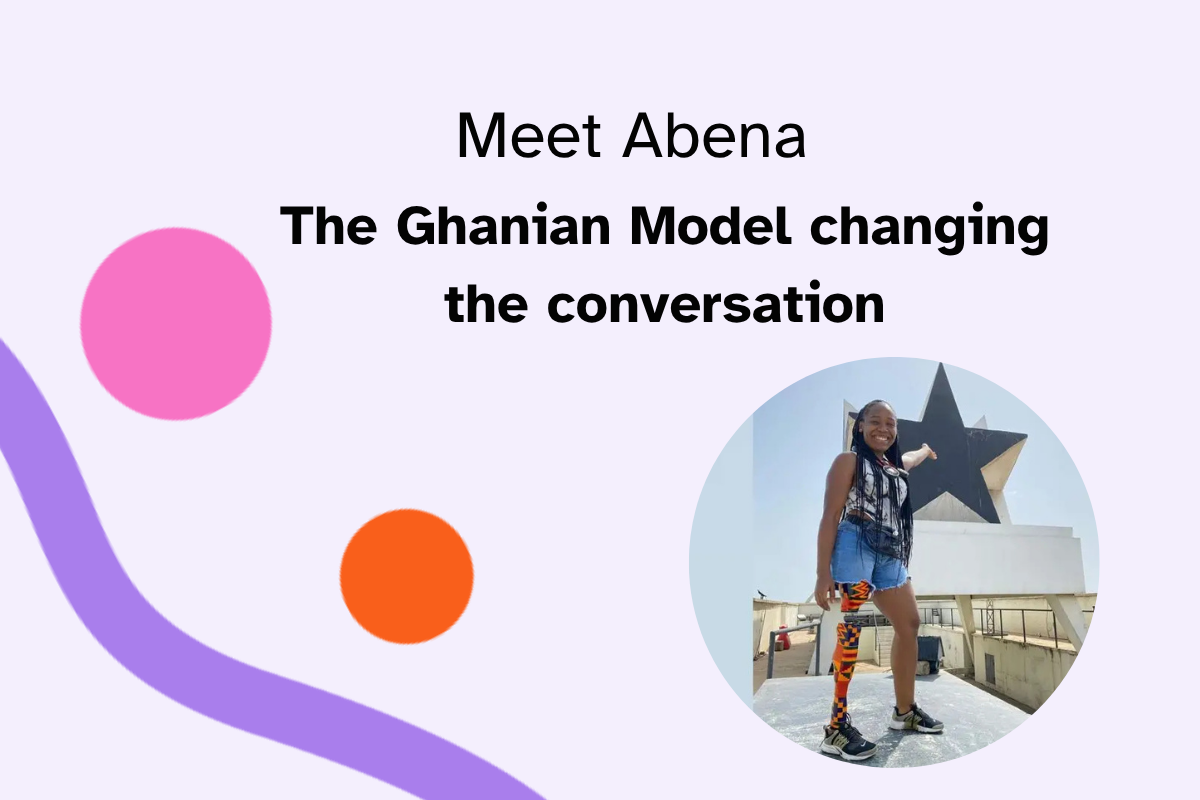
But in December ‘Rhythms on the Runway’ in Accra made a remarkable statement with their ‘Black Star’ show which resonated far beyond the catwalk. Ghanaian-American model and writer Abena Christine Jon’el stole the spotlight with her prosthetic leg uniquely wrapped in vibrant Kente cloth, a traditional Ghanaian cloth, rich in cultural significance.
By customising her prosthetic leg Abena challenged the conventional perceptions and inspired others to embrace their disability as her bold colourful catwalk sent a strong message - disability is not about limits as she embodied strength, beauty, and determination.
Abena’s story is a sad one but she does not invite pity. At two years old, Abena was diagnosed with a large cancerous tumour on her right lower leg. It was a rare and aggressive form of soft-tissue cancer called rhabdomyosarcoma. Her mother had to choose between radiation therapy or her toddler daughter having an amputation. Her mother chose to amputate and Abena celebrates this decision.
Born to celebrate difference
Growing up in Chicago, Abena has always been proudly Ghanaian and moved back to her home country having always felt something was missing, she now finally feels whole. "Leaving felt like being torn away from somewhere my soul belonged. I am not African because I was born in Africa, but because Africa was born in me.”
Living with a disability in Ghana has brought a new mission into her life, one that goes far beyond personal expression. Abena noticed the difference between how disabled people are treated in America and Ghana. Progress for the disabled community in America is slow but it is there, whilst in Ghana, Abena feels the country is very much at the beginning, but this is not due to a lack of compassion. It is about visibility and accessibility.
"In Ghana, disabled people have not been widely showcased in a positive light," she says. "So stigma thrives. Negativity thrives. People do not see us in powerful or beautiful or joyful positions, they see us only in struggle" she told the BBC.
This love for her country and celebration of her identity is proudly demonstrated by her prosthetic leg itself and Abena wants Ghanaians to see disabled people as they are: ambitious, stylish, talented, complex, proud and human.
"Disability is not a limitation. Having a disability is not what makes you disabled," she says "lack of support, lack of accessibility, that is what disables you."
Express yourself
By covering her prosthetic it becomes more of her, both as part of her body and in a way to express her identity, as a proud Ghanaian woman. In redefining her prosthetic she paves the way for a new generation to embrace their differences with confidence. In a world that often overlooks the needs of disabled individuals, Abena’s courage is a beacon of hope and inspiration, reminding us all that diversity in ability should be celebrated, not hidden.
Never Grey brands like Limb Art and Orthotic Transfer also celebrate individuality, with systems that plaster your prosthetic or orthotic with a chosen design. Limb ART offers a cloth matching service for your prosthetic to match your outfit and Orthotic Transfers allows for an at-home application with their innovative, step by step instructions.
Abena’s story makes a powerful statement, proving that fashion, culture, and advocacy can coexist beautifully and Never Grey brands are changing the conversation and bringing this same opportunity to personalise your prosthetic or orthotic to you.
Please note: Never Grey are not responsible for content found on third party websites